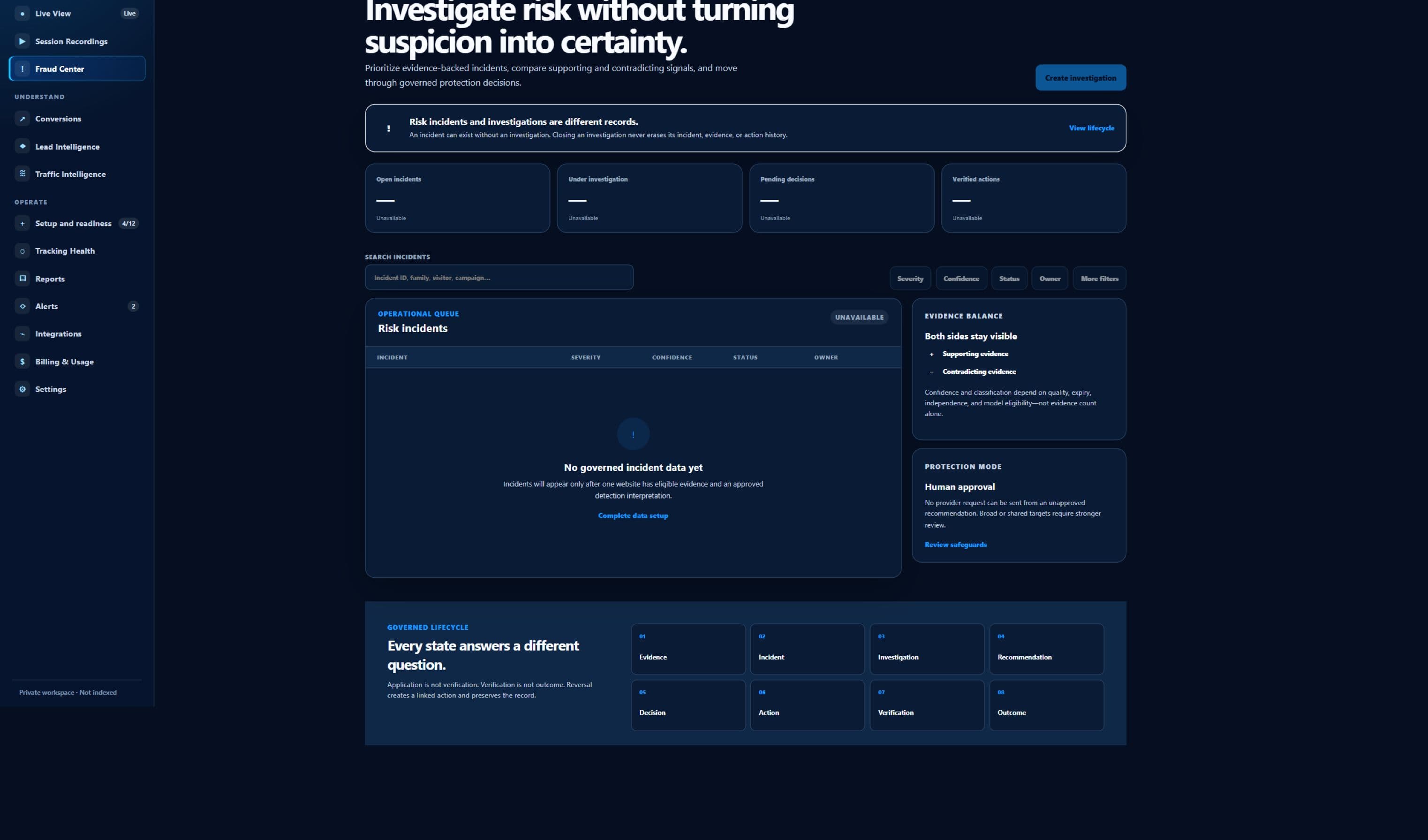
The question this workflow owns
Which eligible observations support a risk assessment at the selected grain, with which reasons, confidence, coverage, freshness, and limitations? This page is written for fraud analysts, paid-media operators, data teams, agencies, governance reviewers, and buyers evaluating how ClickGuardIQ reaches a risk assessment. Its owner is versioned evidence eligibility, signal calculation, reason contribution, confidence, coverage, and classification, so adjacent product surfaces can reference the result without silently changing its meaning or authority.
The supported decision is whether the selected click, session, visitor, incident, or other supported entity remains unclassified, warrants review, meets a policy-supported classification, or requires no classification. That decision remains qualified by the selected property or client, eligible population, time window, filters, definitions, coverage, freshness, permissions, and evidence available when the workflow runs.
- Workflow owner: versioned evidence eligibility, signal calculation, reason contribution, confidence, coverage, and classification
- Audience: fraud analysts, paid-media operators, data teams, agencies, governance reviewers, and buyers evaluating how ClickGuardIQ reaches a risk assessment
- Supported decision: the selected click, session, visitor, incident, or other supported entity remains unclassified, warrants review, meets a policy-supported classification, or requires no classification
Inputs retain their original meaning
Inputs can include eligible click, acquisition, visitor, session, behavioral, device, network, location, automation, conversion, lead, tracking-health, customer, or provider evidence defined for a specific model and scope. An observed event, calculated metric, inferred relationship, customer-provided field, provider-reported state, and human decision are different evidence types. The workflow records which type produced each value instead of flattening all of them into a generic fact.
Each assessment retains its entity grain, eligible population, model and rule versions, source observations, contributing and opposing reasons, coverage, confidence, freshness, unavailable inputs, calculation time, and prior snapshots. Source identity, event time, ingestion time, calculation time, definition or model version, eligible scope, confidence, coverage, freshness, and correction history travel with the result wherever the interface presents it.
Boundaries remain visible
A metric describes a population, a signal describes an eligible observation or pattern, risk combines versioned evidence, confidence describes assessment support, and classification is a separate policy or reviewer conclusion. This distinction prevents collection from being treated as acceptance, a signal as confirmation, a recommendation as execution, an attempt as provider application, or an applied state as a verified business result.
When a required input, permission, provider capability, identity link, outcome, or correction path is missing, the method narrows the supported result or returns unavailable, incomplete, unclassified, needs-review, failed, expired, or unknown. It does not replace missing evidence with an authoritative-looking estimate.