Color theme
Sign inRequest beta access

Built for your workflow

Separate automation signals from defensible risk conclusions.

Evaluate behavior, network, device, velocity, and consistency signals while keeping uncertain activity unclassified.

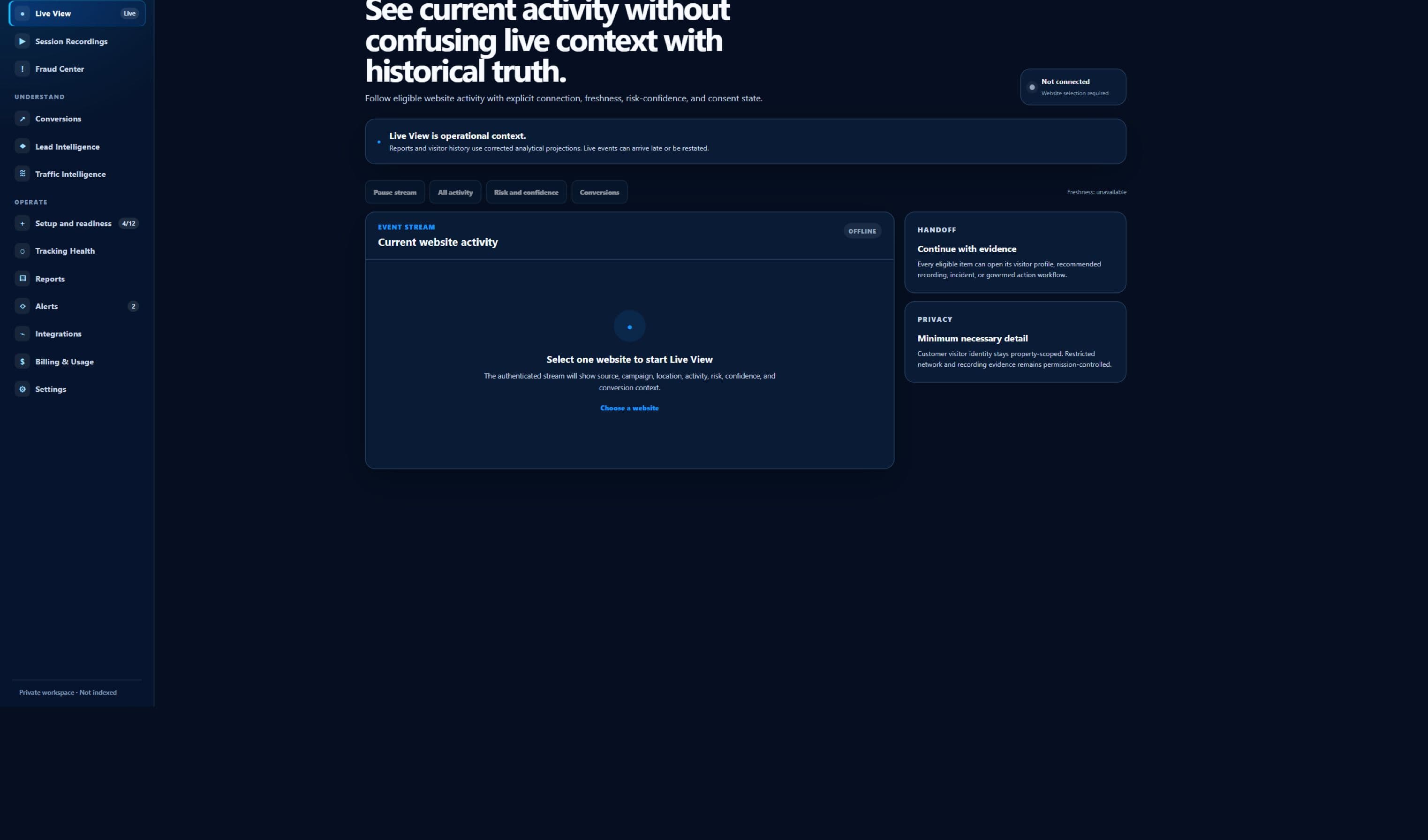
Sanitized beta interface — no customer data
Sanitized ClickGuardIQ Live View interface showing its current setup state.
Live ViewCurrent beta interface; the capture does not imply that a live customer stream is connected.

Recognize the operating problem

Invalid Traffic and Bot Detection starts with a question the evidence can actually answer.

The solution is framed around the buyer's decision, the measurable population, and the operational boundary—not an unsupported savings or detection promise.

What teams are trying to solve

Automation, invalid traffic, legitimate monitoring, shared networks, accessibility tools, privacy technology, fast users, and instrumentation errors can create overlapping technical patterns. The page is designed for fraud investigators, analysts, security-aware growth teams, and operators evaluating automated or otherwise invalid website activity. It begins with the operational question rather than assuming every unusual pattern has the same cause or deserves the same response.

A useful solution must show which records belong to the question, which evidence is eligible, which data is missing, and what decision is permitted next. The decision remains bounded by website, time window, eligible events and sessions, identity confidence, environment, known infrastructure, signal versions, coverage, and investigation state. That context remains visible when a user filters, compares, investigates, exports, or follows a link into another product surface.

Before configuration, the team should document its current data sources, ownership, review threshold, response authority, and exception process. That baseline lets the beta review distinguish a missing product capability from incomplete measurement, an external dependency, or an operating-policy decision that belongs to the customer.

What a defensible outcome looks like

A defensible outcome combines multiple eligible signal families, preserves confidence and counterevidence, distinguishes technical observation from intent, and retains an unclassified state when the cause is uncertain. The outcome is not one universal score. It is an attributable path from measured evidence to a qualified conclusion, with confidence and limitations visible at the moment the team decides what to do.

The decision supported by this solution is whether activity needs more evidence, is expected automation, is measurement noise, is suspicious, can be confirmed under policy, or supports a governed response. When evidence is insufficient, conflicting, stale, or outside the selected scope, the product should preserve an unavailable, unclassified, or needs-review state rather than manufacture certainty.

Success criteria should be agreed before the evaluation window opens. Reviewers can then test whether another authorized operator can reproduce the population, read the reasons and limitations, reach a policy-supported decision, and trace every later handoff without relying on undocumented assumptions.

  • Audience: fraud investigators, analysts, security-aware growth teams, and operators evaluating automated or otherwise invalid website activity
  • Decision: activity needs more evidence, is expected automation, is measurement noise, is suspicious, can be confirmed under policy, or supports a governed response
  • Scope: The decision remains bounded by website, time window, eligible events and sessions, identity confidence, environment, known infrastructure, signal versions, coverage, and investigation state.

Where the solution stops

Bot and invalid-traffic detection does not claim that automation is always malicious, that one IP or device identifies a person, or that unusual behavior automatically confirms fraud. This protects the buyer from a common failure: treating detection as confirmation, a recommendation as an applied action, or an applied action as a verified commercial result.

Tracking Health owns instrumentation defects, Live View owns recent eligible activity, Visitor Intelligence owns measured journey context, and Fraud Center owns the attributable incident decision. The solution therefore links to the relevant Platform record, methodology, provider status, privacy control, or reporting surface when the next question belongs there. That division keeps each page useful without pretending one workflow replaces the whole operating stack.

If a required provider field, identity key, permission, event, outcome, or correction path is unavailable, the responsible result is a disclosed limitation and a narrower supported workflow. It is not a silent estimate, fabricated connection, automatic fraud verdict, or promise that operational action produced financial value.

Solution capabilities

What Invalid Traffic and Bot Detection helps the team do.

Capabilities are described through evidence and workflow behavior. They do not imply unsupported provider access, automated blocking, or guaranteed performance.

Combine independent signal families

Review behavior, timing, velocity, consistency, device, network, environment, acquisition, identity, and historical context without one indicator dominating.

Version every calculation

Retain model or rule version, eligible evidence, reason contribution, confidence, coverage, exclusions, and calculation time.

Recognize expected automation

Allow known monitoring, testing, partner, internal, accessibility, or customer-approved activity to be represented without deleting source evidence.

Preserve counterevidence

Show conflicting observations and legitimate explanations rather than collecting only the signals that support suspicion.

Avoid identity overreach

Keep website-scoped visitor, browser, device, network, and approved known identity as distinct confidence-bearing concepts.

Correct and recalculate

Retain reviewer decisions, allowlist or classification changes, identity corrections, and affected recalculations as an auditable history.

Practical situations

Use the solution when the business question needs a traceable answer.

Each situation begins with a recognizable operating problem and ends with a qualified next step—not a fictional customer result.

High-velocity page activity

Check event validation, sessionization, network, device, timing, known automation, historical behavior, and coverage before deciding.

Repeated visits from one network

Consider shared offices, carriers, VPNs, proxies, privacy tools, and multiple devices instead of treating the network as one actor.

A monitoring tool resembles a bot

Identify approved purpose, environment, signature, owner, schedule, and scope while preserving the source activity and policy history.

Signals disagree

Keep the incident unclassified, request more evidence, compare model versions, and record why the current conclusion remains limited.

From question to decision

A governed invalid traffic and bot detection workflow.

Measurement, calculation, investigation, decision, action, and verification remain distinct so teams can explain the path and correct it later.

  1. 01

    Validate measured activity

    Confirm property, environment, consent, event acceptance, identifiers, sessionization, tracking health, and eligible population.

    Malformed or duplicated tracking can resemble automated behavior.
  2. 02

    Calculate multi-signal risk

    Apply versioned behavior, timing, network, device, consistency, acquisition, and history signals with contribution and confidence.

  3. 03

    Check legitimate explanations

    Review known automation, shared infrastructure, privacy tools, customer activity, testing, accessibility, and counterevidence.

  4. 04

    Record an attributable decision

    Keep unclassified, expected automation, dismissed, suspicious, or confirmed states separate from the original observations.

  5. 05

    Apply governed follow-up

    Use monitoring, allowlist review, measurement repair, incident escalation, or supported protection with policy and correction history.

Evidence and readiness

Know what is real, beta, limited, or provider-dependent.

Public product captures are sanitized, conceptual art is labelled, and external capabilities require validation for the proposed account and workflow.

Product evidenceavailable

Sanitized Live View and Fraud Center

Relevant captures show interface readiness without customer streams, bot totals, incidents, scores, or blocked activity.

Detectionbeta

Versioned multi-signal beta

Signal families and explainability are defined; accuracy, recall, false-positive, and production performance are not claimed.

External contextexternal

Known automation requires customer input

Monitoring, testing, partners, internal networks, accessibility tools, and approved automation depend on customer context.

Classificationlimited

Uncertainty remains available

The workflow does not force every unusual pattern into malicious bot, invalid traffic, or legitimate traffic.

Compare operating behavior

Evaluate Invalid Traffic and Bot Detection beyond a feature checklist.

The comparison is qualified and approach-based. It does not claim that every alternative product behaves the same way.

Evaluate Invalid Traffic and Bot Detection beyond a feature checklist.
ComparisonSingle-indicator bot labelEvidence-led invalid-traffic review
SignalsLets IP, velocity, user agent, or behavior alone determine the label.Combines independent signal families with contribution, confidence, coverage, and counterevidence.
IdentityTreats one browser, device, network, or cookie as a known person.Keeps technical identifiers and approved identity links distinct and confidence-bearing.
AutomationAssumes automated activity is always malicious or invalid.Represents known monitoring, testing, internal, partner, and approved automation explicitly.
UncertaintyForces every event into bot or human.Allows insufficient evidence, conflicting evidence, unclassified, and needs-review states.
CorrectionOverwrites a label after allowlisting or model change.Retains prior version, reviewer decision, policy change, correction reason, and recalculation history.

A buyer-ready evaluation standard

Define success using evidence the organization can verify.

A credible beta evaluation starts with data readiness, decision quality, governed handoffs, and independently checkable outcomes.

Measurement before interpretation

Begin with validated events and sessions, known health state, environment, consent, source provenance, and eligible signal families before calculating automation or invalid-traffic risk. Every important result should disclose property or client, period, timezone, filters, eligible population, exclusions, freshness, coverage, and the definition or model version used.

Collection failure, consent exclusions, sampling, provider delay, identity uncertainty, and incomplete external outcomes can all change what the product can conclude. They remain visible at the point of use and in reports or exports so missing evidence cannot look like improvement.

A governed team handoff

Tracking Health owns instrumentation defects, Live View owns recent eligible activity, Visitor Intelligence owns measured journey context, and Fraud Center owns the attributable incident decision. Assignments, notes, approvals, corrections, provider responses, and downstream delivery states remain attributable to the user or system that created them.

A recommendation is not an attempt; an attempt is not provider application; provider application is not verification; and verification is not automatic proof of savings, revenue, lead quality, or optimization impact. Permissions and reversal remain part of the path wherever action is supported.

Proof without invented outcomes

Evaluate whether the system can explain supporting and opposing evidence, preserve model and rule versions, avoid unsafe identity assumptions, and let reviewers correct false or uncertain classifications. The evaluation should identify the evidence available before activation, the decisions operators must reproduce, the unsupported requirements that must stop the workflow, and the outcome checks the organization controls.

This page does not use invented testimonials, logos, reviews, benchmark statistics, detection rates, recovered-spend totals, conversion uplift, or sales claims. A public screenshot demonstrates interface readiness only; it never substitutes for a customer result or provider verification.

Invalid Traffic and Bot Detection questions

Clarify fit, limitations, and the next responsible step.

The answers describe the intended beta operating model and avoid promising integrations or outcomes that have not been validated.

Is all automated traffic invalid or malicious?

No. Monitoring, testing, search crawlers, partner systems, internal tools, accessibility technology, and customer-approved automation can be legitimate. Purpose, authorization, scope, behavior, and customer policy matter.

Can an IP address prove one bot or one person?

No. Networks can be shared, translated, proxied, mobile, corporate, privacy-protected, or reassigned. An IP address can contribute technical context but should not silently become a stable person or fraud conclusion.

How are uncertain sessions handled?

They can remain unclassified or needs-review when evidence is insufficient, conflicting, stale, or ineligible. The system should show confidence, coverage, reasons, counterevidence, and the calculation version.

Can tracking errors look like bot behavior?

Yes. Duplicate firing, malformed events, missing identifiers, clock errors, retries, test environments, and sessionization problems can create artificial velocity or consistency. Tracking Health must remain a separate diagnosis.

Can known automation be allowlisted?

A customer-approved policy may represent known activity, but the source evidence, owner, purpose, scope, expiry, reviewer, and change history should remain visible. Allowlisting should not erase what was measured.

Does ClickGuardIQ publish a bot-detection accuracy rate?

Not without approved methodology and evidence. This page makes no accuracy, recall, false-positive, coverage, benchmark, or blocked-traffic claim. A beta evaluation should define representative evidence and review standards.

Evaluate fit without overpromising

Define the automation and invalid-traffic questions your evidence can support.

Share properties, environments, event contracts, known automation, investigation policies, signal needs, and correction requirements. The beta review will clarify measurable and uncertain boundaries.