Color theme
Sign inRequest beta access

Learn with clarity

Help foundation

Find the next safe step when something needs attention.

The Help Center will connect setup, tracking, integration, privacy, investigation, reporting, and account guidance to clear impact and remediation paths as capabilities ship.

Sanitized beta interface — no customer data
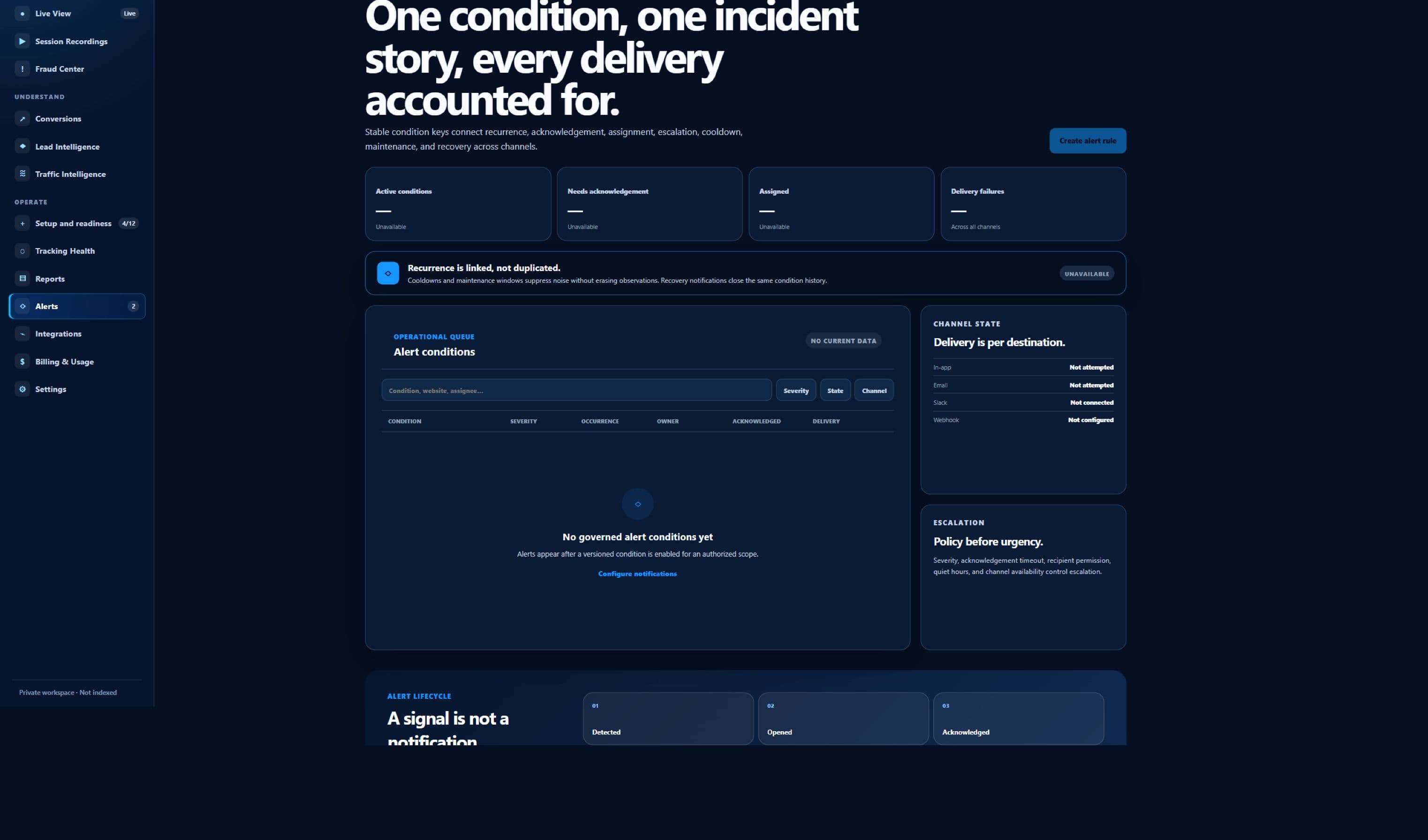
Sanitized ClickGuardIQ Alerts workspace showing its current configuration state.
AlertsCurrent beta interface captured without customer alert events or notification-delivery claims.

Learn before deciding

ClickGuardIQ Help Center is organized around questions, evidence, and a responsible next step.

The resource exists to help a reader understand and evaluate—not to turn uncertainty into fear or disguise commercial claims as education.

What this resource helps readers do

The help center starts from a symptom, affected scope, impact, last trustworthy state, recent changes, current diagnostics, and safe remediation so users do not have to guess the internal component first. The primary audience is website owners, administrators, operators, analysts, investigators, agencies, developers, privacy and security teams, and beta users resolving a product or data issue. Content begins with the reader's real task, defines the relevant terms, and identifies which product, provider, legal, privacy, or business decision remains outside the article or guide.

A useful answer explains the eligible evidence, population, grain, timeframe, geography where relevant, definition, method, uncertainty, limitations, and practical sequence. It also links to the workflow or product surface that owns the next operational question instead of repeating a generic conversion pitch.

  • Audience: website owners, administrators, operators, analysts, investigators, agencies, developers, privacy and security teams, and beta users resolving a product or data issue
  • Learning goal: The help center starts from a symptom, affected scope, impact, last trustworthy state, recent changes, current diagnostics, and safe remediation so users do not have to guess the internal component first.
  • Boundary: The help center can guide diagnosis and escalation but cannot access an account through the public page, restore an external provider, provide legal advice, or promise recovery, delivery, action, data completeness, or business results.

How evidence is handled

Help content uses current product and version evidence, relevant provider guidance, known status, and reproducible diagnostics; unverified workarounds and planned capabilities are not presented as fixes. Material factual claims should identify the publisher, source, relevant publication or update date, and the context in which the finding applies. Primary provider, standards, government, or original-method sources are preferred where available.

Every support path separates configuration, permission, collection, validation, processing, freshness, calculation, investigation, external action, provider response, verification, reporting, and customer-environment responsibility. Observed activity, calculated metrics, signals, risk, suspicion, policy classification, provider action, verification, estimates, credits, savings, conversion quality, and commercial outcomes retain different meanings throughout the resource family.

What the resource does not claim

The help center can guide diagnosis and escalation but cannot access an account through the public page, restore an external provider, provide legal advice, or promise recovery, delivery, action, data completeness, or business results. A guide can help structure an evaluation, but it cannot confirm a specific visitor's intent, replace provider policy, create unavailable product capability, provide legal advice, or guarantee detection, blocking, savings, conversion, lead, revenue, or ROI outcomes.

Content states publication or modification context, visible limitations, related definitions, and the safest next step. If a material source, provider behavior, product capability, or interpretation changes, the correction should update the visible content and date without pretending the earlier publication never existed.

What you can learn

Explore the core areas within clickguardiq help center.

Each pathway is specific enough to answer a reader question and broad enough to connect the answer to methodology, product, privacy, security, or implementation evidence.

Website and tracking

Resolve property mapping, environment, SDK version, consent, event creation, duplicate installation, delivery, validation, processing, coverage, and freshness.

Integrations and permissions

Check current availability, credentials, authorization, scopes, accounts, destinations, schemas, limits, provider state, retries, verification, and disconnection.

Visitors, sessions, and recordings

Review identity scope, session rules, event provenance, consent, masking, sampling, access, unavailable evidence, retention, and corrections.

Risk and investigations

Understand entity grain, eligible evidence, reasons, confidence, coverage, incidents, assignments, decisions, action handoffs, recalculation, and history.

Reports, alerts, and exports

Validate definitions, populations, filters, timezones, freshness, delivery, schedules, formats, permissions, partial state, and last trustworthy data.

Account, security, and privacy

Handle roles, client and website boundaries, credentials, sensitive access, consent, retention, deletion, audit, incident evidence, and approved escalation.

Start from the task

Choose a path based on what you need to understand or resolve.

Task-led navigation reduces guesswork and keeps definitions, evidence, limitations, and escalation context attached to the problem.

Something stopped updating

Record last trustworthy time, affected records and filters, expected freshness, tracking and integration health, provider delays, recent changes, errors, and scope before remediation.

A number looks wrong

Check definition and version, entity grain, eligible population, filters, period, timezone, attribution, exclusions, freshness, late data, corrections, and comparison compatibility.

An external action is unclear

Open capability, permission, recommendation, decision, request, attempt, provider response, application interpretation, verification, error, expiry, reversal, and audit history.

The issue needs escalation

Provide organization and permitted client or website scope, time window, environment, version, provider, correlation identifiers, safe evidence, impact, recent changes, and attempted steps.

Evidence-aware learning path

Five stages for using clickguardiq help center responsibly.

The sequence moves from the reader's question to source review, practical application, validation, and a documented next step without turning education into an unsupported verdict.

  1. 01

    Describe symptom and affected scope

    Record what changed, expected and observed behavior, organization, client, website, account or destination, environment, role, version, start time, and impact.

    Do not include passwords, tokens, full payloads, unnecessary personal data, recordings, or sensitive customer evidence in an unapproved support channel.
  2. 02

    Find the last trustworthy state

    Identify the last known-good configuration, permission, event, sync, calculation, report, action, provider response, verification, version, and timestamp.

  3. 03

    Check stage-specific diagnostics

    Review authentication, consent, capture, queue, delivery, validation, processing, freshness, eligibility, model, provider, report, alert, export, permission, and errors as relevant.

  4. 04

    Apply a bounded remediation

    Change the smallest supported scope, preserve evidence, avoid broad destructive resets, validate prerequisites, document the step, observe effect, and retain rollback or reversal.

  5. 05

    Verify recovery or escalate

    Confirm the strongest restored state, affected historical data, remaining gaps, corrections, retries, provider dependency, monitoring, and the safe evidence support needs next.

Publication and product boundary

Know which evidence is published, current, external, limited, or planned.

Visible status helps readers distinguish finished educational material and product documentation from provider-controlled facts, planned capabilities, and unsupported outcomes.

Help modelavailable

Issue-first support foundation

The page defines symptom, impact, last trustworthy state, diagnostics, safe remediation, verification, and escalation evidence across current product areas.

Beta operationsbeta

Capability-specific guidance

Current product and documentation can support bounded beta troubleshooting; detailed account and provider procedures expand with validated capabilities.

Providers and customer systemsexternal

Externally controlled recovery

Websites, browsers, consent tools, ad providers, CRMs, destinations, networks, hosting, and permissions can require external owners or support.

Guaranteed restorationlimited

Not promised

The public help center cannot guarantee data recovery, provider availability, message delivery, action completion, historical backfill, or commercial outcome.

Quality review

Evaluate clickguardiq help center by usefulness and evidence discipline.

The comparison describes editorial approaches; it does not make unsupported claims about every competing resource or publisher.

Evaluate clickguardiq help center by usefulness and evidence discipline.
ComparisonGeneric reset troubleshootingEvidence-preserving issue resolution
Starting pointAsks users to choose an internal component and repeat setup without defining impact.Starts from symptom, expected and observed behavior, affected scope, time, environment, role, version, impact, and recent change.
Data stateAssumes all data is wrong or all data is healthy.Identifies last trustworthy configuration, source, period, population, freshness, version, provider state, and records affected or still reliable.
RemediationReinstalls, reconnects, deletes, or resets broadly without evidence or rollback.Uses the smallest supported change, preserves diagnostics and history, documents actor and time, validates effect, and retains rollback or reversal.
SecurityRequests tokens, passwords, full payloads, recordings, or personal data in ordinary messages.Uses safe correlation identifiers, scoped redacted evidence, approved channels, minimum access, audit, retention, and incident escalation.
ResolutionCloses when one screen looks normal without checking gaps or history.Verifies the strongest restored stage, historical impact, backfill or correction, remaining limits, external dependencies, monitoring, and owner.

Editorial and maintenance contract

A trustworthy resource remains inspectable after publication.

Authorship, review, dates, sources, limitations, corrections, internal links, and assistance safeguards travel with substantive content.

Sources and interpretation

A source is selected because it supports the specific nearby statement—not because its title contains the target keyword. The resource distinguishes what the source directly reports from ClickGuardIQ interpretation, product method, an illustrative example, or a recommendation for evaluation.

Statistics require extra context: publisher, original source, observation and publication dates, sample, geography, platform, eligibility, definition, method, uncertainty, and limitations. A narrow historical estimate must not become a global, current, or universal market fact through repetition.

  • Primary sources where available
  • Source findings separated from interpretation
  • Statistics retain sample, date, geography, and limitations

Authorship, assistance, and corrections

The ClickGuardIQ Editorial Team is a collective author identity for product, research, and editorial review. Named individuals should appear only when real reviewers approve publication and their role can be stated accurately. Automation may help organize drafts or check consistency but is never treated as evidence.

Material corrections should identify what changed, why it changed, the source or evidence reviewed, and the new modification date. Provider-specific instructions and product capability statements require rechecking because APIs, interfaces, policies, fields, permissions, and availability can change.

From learning to action

Internal links should help a reader move between precise definitions, research standards, practical guides, articles, methodology, product modules, integrations, privacy, security, pricing, and contact—without creating near-duplicate pages solely for search traffic.

The final action must match the reader's stage. Educational pages can point to another guide, a glossary definition, documentation, the relevant workflow, an integration-status review, or a beta fit review. They do not use instant purchase, public free-trial, automatic installation, or guaranteed-result language.

ClickGuardIQ Help Center questions

Clarify scope, evidence, maintenance, and the next useful path.

Answers are written for extraction by readers and answer systems while keeping qualification, limitations, and ownership visible.

What information should I collect before asking for help?

Record the symptom, expected behavior, affected organization, client, website, account or destination, environment, role, version, start time, last trustworthy state, impact, recent changes, current health, safe error or correlation identifiers, and attempted steps.

Should I disconnect and reconnect an integration first?

Not automatically. Broad reconnection can change permissions, tokens, account scope, freshness, provider state, in-flight work, and audit evidence. First identify the failed capability and stage, preserve evidence, and use the smallest supported remediation.

What does last trustworthy state mean?

It is the latest configuration, event, sync, metric, assessment, report, alert, action, provider response, or verification that the available evidence supports as reliable for a defined scope. Later records may be delayed, incomplete, stale, or unavailable.

Can I send credentials or customer data to support?

Do not send passwords, tokens, secret values, full payloads, unnecessary personal data, recordings, or sensitive customer evidence through an unapproved channel. Use minimum scoped, redacted evidence and the authorized support or security process.

How do I know an issue is resolved?

Verify the strongest relevant stage: configuration, permission, collection, validation, durable acceptance, processing, freshness, calculation, report, delivery, provider application, or independent verification. Also record historical impact, remaining gaps, correction, monitoring, and owner.

Can support guarantee recovery of missing data?

No. Recovery depends on whether the source event existed, was permitted, retained, delivered, durably accepted, processable, compatible with current definitions, and still available from external systems. Limitations and unrecoverable gaps should remain visible.

Use the next resource that matches your question

Escalate with the scope, timeline, and safe evidence needed to continue.

Include the symptom, affected scope, version and environment, last trustworthy state, impact, recent changes, current health, safe correlation identifiers, and bounded steps already attempted.