Color theme
Sign inRequest beta access

ClickGuardIQ platform

Know whether your data is ready to trust.

Separate setup, stream, integration, incident, recovery, and data-repair health from fraud and traffic-quality outcomes.

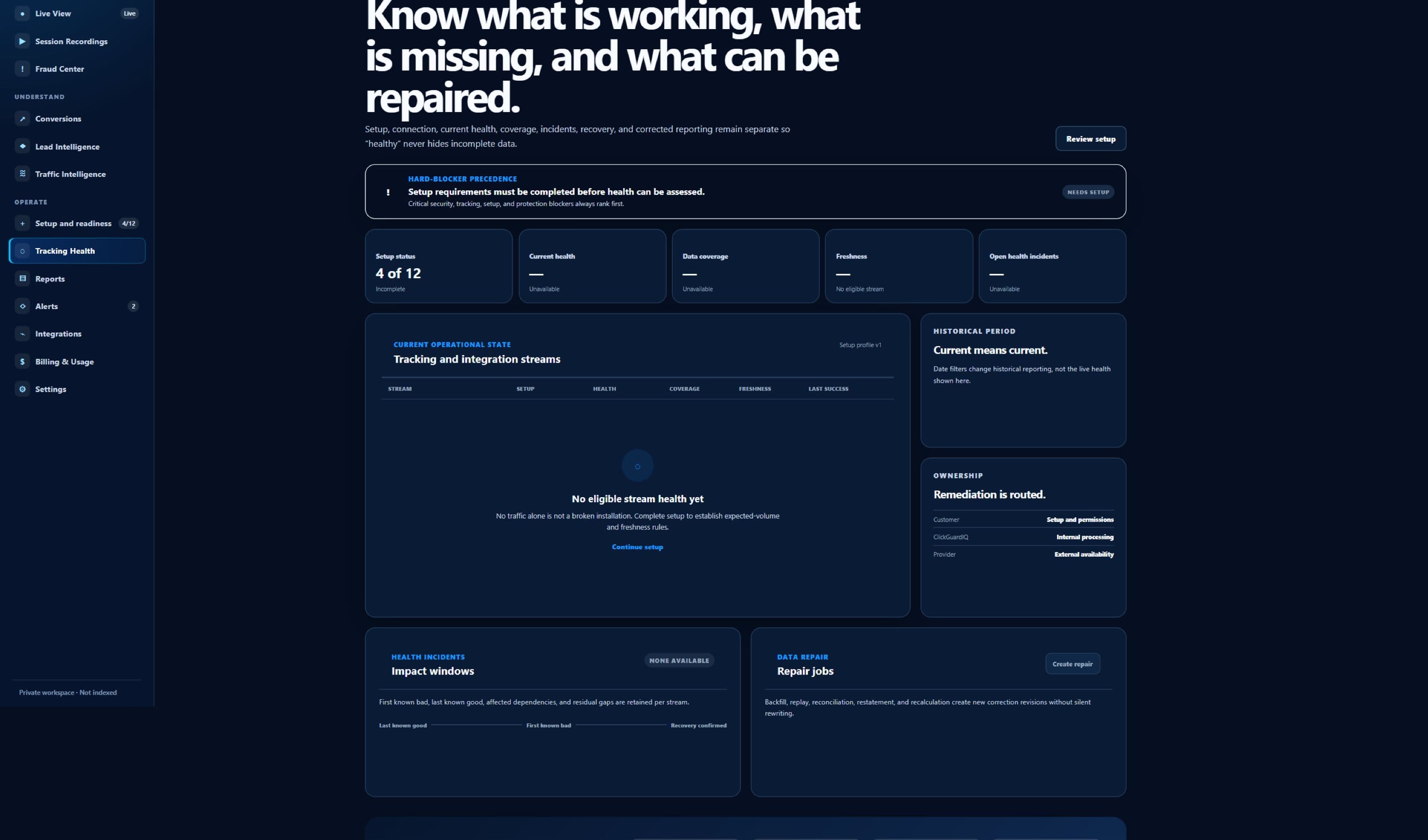
Sanitized beta interface — no customer data
Sanitized ClickGuardIQ Tracking Health workspace showing its current diagnostics state.
Tracking HealthCurrent beta interface captured without implying that a customer property has been tested.

A clearly owned job

Tracking Health has one defined place in the operating model.

The page explains what this surface measures, the decision it can support, and the boundary it does not cross.

The job this surface owns

Tracking Health is designed for analytics, engineering, growth, and operations teams that need to know whether collection and connected data are ready to support a decision. Its primary record is a property-scoped health model covering setup, consent, acceptance, validation, identifiers, duplication, delay, loss, integration state, incidents, recovery, and repair. That focus matters because a useful operating surface should answer a specific question before it asks a team to act. Here, the question is whether data is ready for its intended use, degraded with disclosed impact, unavailable, recovering, or requires a permitted remediation. The answer stays attached to the evidence and scope that produced it.

Health remains bounded by website, environment, expected event and identifier contract, consent mode, ingestion stream, integration, incident interval, and last trustworthy state. That scope travels with summaries, filters, exports, and follow-up links so a number is not separated from the population it describes. When the required evidence is absent, the interface should say that the answer is unavailable or incomplete instead of replacing it with an estimate that looks authoritative.

  • Primary record: a property-scoped health model covering setup, consent, acceptance, validation, identifiers, duplication, delay, loss, integration state, incidents, recovery, and repair
  • Decision supported: data is ready for its intended use, degraded with disclosed impact, unavailable, recovering, or requires a permitted remediation
  • Designed for: analytics, engineering, growth, and operations teams that need to know whether collection and connected data are ready to support a decision

A deliberate evidence boundary

Tracking Health diagnoses measurement readiness; it does not label visitors as fraudulent, grade traffic quality, or interpret missing data as business performance. ClickGuardIQ preserves this distinction because a high-risk signal, an unusual pattern, a tracking defect, and confirmed invalid activity are not interchangeable findings. Each can change what an investigator checks next, but none should silently inherit the certainty of another.

Each incident retains detection source, affected contract, first and last observation, impact, evidence, remediation, recovery, and any data-repair state. The operating record keeps source observations, calculated signals, human notes, decisions, provider responses, and verified outcomes attributable. Corrections create a history rather than rewriting the earlier state, which keeps later reporting and review understandable.

How it fits daily work

Setup checks, incoming events, validation, delay, loss estimates, integration polling, incident detection, backlog recovery, and repair verification have separate update cycles. This prevents a recent partial stream from being compared casually with a completed historical period. It also gives an operator a direct route to the underlying visitor, session, incident, conversion, lead, campaign, integration, or delivery record when more detail is justified.

Installation details, security configuration, diagnostic payloads, integrations, repair actions, and environments remain limited to authorized roles and safe disclosure. Access is therefore part of the product model, not an afterthought. Sensitive evidence, exports, provider actions, and administrative changes should remain limited to the appropriate website, client, role, and purpose, with an audit trail that explains who did what and when.

Feature detail

What Tracking Health is designed to help teams do.

Each capability keeps its underlying scope and limitations visible so convenience does not come at the expense of explainability.

Verify setup readiness

Check property registration, installation, environment, consent behavior, required identifiers, event definitions, security requirements, and expected integrations.

Monitor stream health

Separate received, accepted, rejected, duplicated, delayed, lost, sampled, and recovered activity with the affected window and population.

Validate event contracts

Identify missing, malformed, incompatible, or unexpected fields and disclose which downstream metrics or workflows can no longer be trusted.

Track integration health

Distinguish authentication, permission, mapping, synchronization, provider, rate, and delivery problems from collection failures.

Preserve the last trustworthy state

Mark the boundary before degradation so reports do not silently mix reliable historical data with an incomplete incident period.

Guide safe remediation

Explain impact and the next permitted check, fix, reconnect, replay, or validation without exposing secrets or promising automatic repair.

Working situations

Use it when the next question needs evidence, not a guess.

These workflows describe practical investigation and operating needs; they are not promises of a particular savings, detection rate, or commercial result.

Validate a launch

Confirm expected events, identifiers, consent behavior, source attribution, security controls, and integration mappings before teams interpret traffic or conversion data.

Diagnose a sudden drop

Check rejection, consent, deployment, identifier, routing, delay, loss, and provider state before treating reduced measurement as reduced demand.

Recover after an incident

Retain the affected interval, last trustworthy state, backlog, repair, recovered events, irrecoverable gap, and downstream recalculation status.

Explain an unavailable metric

Link the dashboard or report state to the exact collection or integration blocker and disclose the data needed before the metric can return.

A governed sequence

From a property-scoped health model covering setup, consent, acceptance, validation, identifiers, duplication, delay, loss, integration state, incidents, recovery, and repair to a defensible next step.

The workflow keeps observation, calculation, review, action, and verification separate so uncertainty and responsibility remain visible.

  1. 01

    Define the expected contract

    Register required events, fields, identifiers, sources, consent states, environments, security controls, and integration expectations for the property.

    Health cannot be judged without an explicit expected state.
  2. 02

    Observe collection states

    Measure receipt, acceptance, rejection, duplication, delay, loss indicators, and version compatibility without interpreting visitor intent.

  3. 03

    Open a health incident

    Record affected scope, first observation, severity, downstream impact, evidence, last trustworthy state, owner, and permitted remediation.

  4. 04

    Repair and verify

    Track configuration, deployment, reconnect, replay, or mapping changes separately from observed recovery and validation of expected evidence.

  5. 05

    Rebuild affected outputs

    Identify recoverable and irrecoverable gaps, recalculate compatible summaries, and retain the incident boundary in reports and exports.

Evidence and readiness

Understand the current product boundary before connecting traffic.

ClickGuardIQ is presented as a beta product. Interface evidence is sanitized, provider-dependent capabilities require validation, and unsupported proof is not substituted with generated claims.

Public captureavailable

Sanitized Tracking Health

The product image shows current diagnostics readiness without implying that a customer property was tested or certified.

Health domainsbeta

Separate setup, stream, and integration state

The architecture distinguishes collection health from fraud and traffic outcomes; production checks require beta validation.

Automated repairlimited

Remediation is capability-limited

Some fixes require customer code, consent changes, credentials, provider action, or deployment and cannot be silently completed.

External systemsexternal

Provider status matters

Authentication, permissions, rate limits, API availability, field mapping, and provider incidents can affect health independently.

A more useful comparison

Evaluate Tracking Health by its operating behavior.

This table compares two operating approaches. It does not claim that every alternative product follows the same design or lacks the same controls.

Evaluate Tracking Health by its operating behavior.
ComparisonBasic tag statusOperational Tracking Health
SetupMarks a tag present after one successful request.Checks expected property, environment, consent, event, identifier, security, and integration contracts.
StreamShows events received without acceptance, delay, duplication, or loss context.Separates received, accepted, rejected, duplicated, delayed, sampled, lost, and recovered states.
ImpactReports an error without identifying which metrics or workflows are affected.Links the incident to evidence readiness, last trustworthy state, and downstream limitations.
RecoveryCloses when events reappear.Verifies expected behavior, backlog, gap, repair source, and affected recalculation before resolution.
InterpretationAllows missing tracking to appear as lower traffic or improved fraud rates.Keeps collection failure independent from visitor, quality, risk, conversion, and lead outcomes.

The ClickGuardIQ operating standard

Context remains attached from first observation to final review.

Three controls make the page useful for investigation, governance, and later audit without turning one screen into an unsupported verdict engine.

Scope, eligibility, and freshness

Every important result in Tracking Health should identify the website or client boundary, time range, timezone, filters, eligible population, excluded population, and last successful update. Setup checks, incoming events, validation, delay, loss estimates, integration polling, incident detection, backlog recovery, and repair verification have separate update cycles. A result that cannot disclose those conditions should not be used as if it describes the whole account.

Eligibility is especially important when consent, sampling, integration coverage, event validation, identity state, or provider availability changes what ClickGuardIQ can measure. The interface should reveal those gaps at the point of use and preserve them in reports or exports. That makes an incomplete answer operationally useful without pretending it is complete.

Reasons, versions, and corrections

Each incident retains detection source, affected contract, first and last observation, impact, evidence, remediation, recovery, and any data-repair state. Calculated outputs retain their model, rule, or score version and the eligible evidence available at calculation time. A later recalculation is a new state with a reason, not a silent edit to history. Operators can therefore distinguish what the system observed from what it inferred and what a person later decided.

The same discipline applies to corrections. Identity merges, conversion reconciliation, qualification changes, incident decisions, and provider responses may alter a current view. ClickGuardIQ should keep the earlier record attributable, show the correction source, and rebuild affected summaries from governed records rather than from an unexplained overwrite.

Permissions, actions, and proof

Installation details, security configuration, diagnostic payloads, integrations, repair actions, and environments remain limited to authorized roles and safe disclosure. A recommendation is not an attempted action; an attempt is not a provider-applied change; and an applied change is not a verified outcome. Those states remain separate wherever this surface can contribute to protection, notification, export, or downstream delivery.

This page does not use invented testimonials, customer logos, benchmark statistics, or savings percentages as product proof. The product image is either a sanitized beta capture or clearly labelled conceptual artwork. Commercial evaluation should instead begin with fit, data readiness, provider capability, policy requirements, and the evidence a team needs to verify its own outcome.

Tracking Health questions

Clarify the boundary before making a decision.

These answers describe the intended beta operating model and avoid claiming an integration, outcome, or automation that has not been validated.

Is a successful test event enough to confirm tracking health?

No. It proves only that one event reached one path. Health should also cover expected events, fields, identifiers, consent, validation, duplication, delay, loss, environments, security controls, integrations, and sustained recovery.

Can Tracking Health detect fraud?

No. Its job is measurement readiness. A collection problem can distort risk and traffic-quality views, but it is not visitor intent or fraud evidence. The domains remain separate and link to one another when relevant.

What is the last trustworthy state?

It is the most recent boundary before a known health degradation affected the evidence needed for a metric or workflow. Reports can use it to explain why later data is incomplete rather than mixing periods silently.

Can ClickGuardIQ repair tracking automatically?

Some validated configuration or replay actions may eventually be supported, but many repairs require customer code, tag-manager changes, consent configuration, credentials, permissions, or provider work. Recommendation, attempt, deployment, and verification remain separate.

What happens to data after recovery?

The system should identify backlog, recovered events, irrecoverable gaps, duplicates, corrections, and which downstream summaries can be recalculated. Recovery does not automatically make the whole incident window complete.

Does Tracking Health certify legal compliance?

No. It can represent configured consent and collection states, but it is not legal advice or a universal compliance certification. Customers remain responsible for lawful purpose, consent, disclosure, retention, and jurisdiction-specific review.

Evidence before activation

Define trustworthy measurement before using product conclusions.

Bring expected events, identifiers, consent modes, environments, tag setup, stream volumes, integrations, and recovery requirements. The beta review will map diagnostics and customer-owned fixes.