Color theme
Sign inRequest beta access

Built for your workflow

Manage client protection without crossing client boundaries.

Give agency teams portfolio summaries, delegated client access, website-level evidence, and governed reporting while preserving tenant isolation.

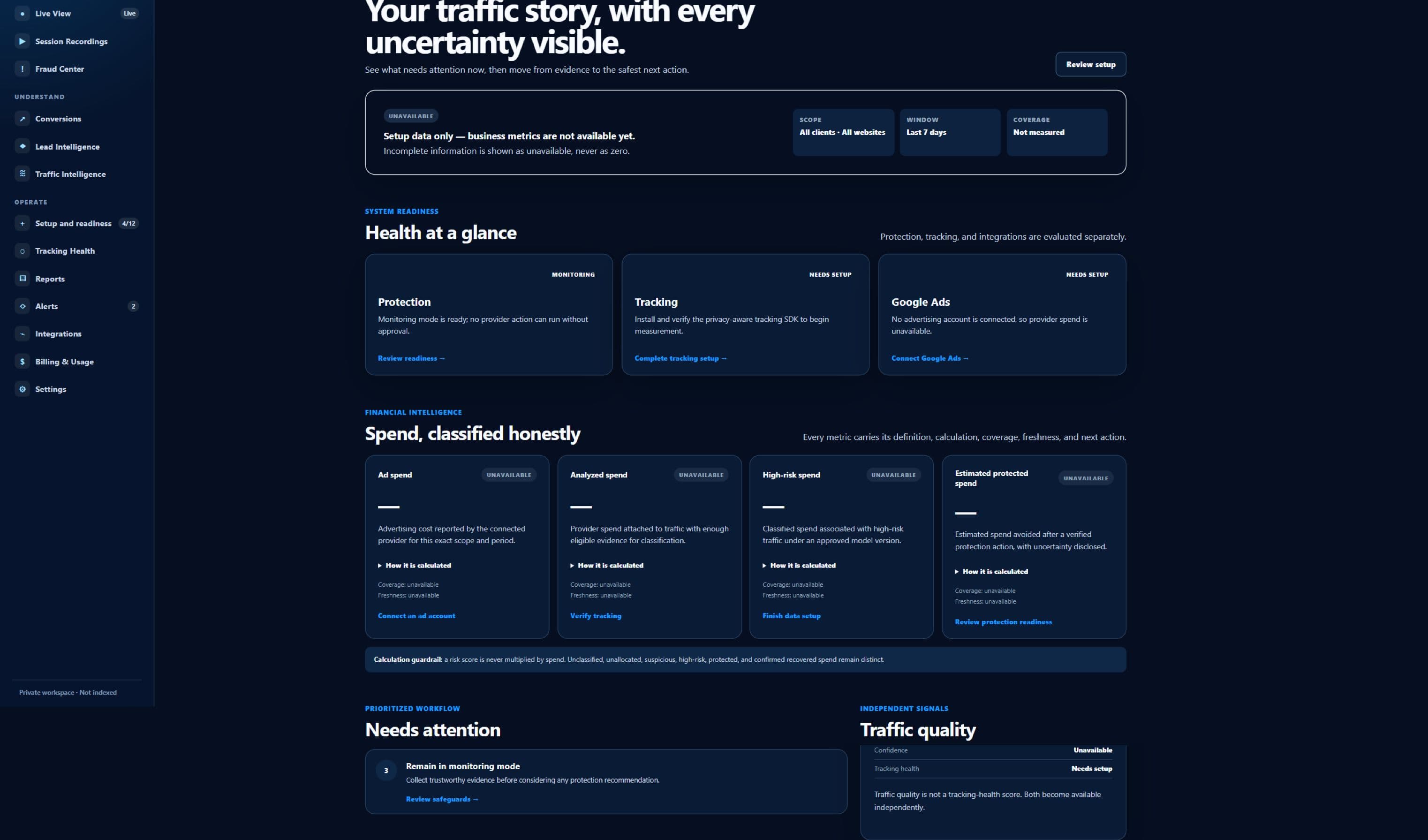
Sanitized beta interface — no customer data
Sanitized ClickGuardIQ Command Center showing setup readiness and unavailable business metrics.
Command CenterCurrent beta interface captured in a sanitized first-run state. Metrics are unavailable rather than fabricated.

Recognize the operating problem

Click Fraud Protection for Agencies starts with a question the evidence can actually answer.

The solution is framed around the buyer's decision, the measurable population, and the operational boundary—not an unsupported savings or detection promise.

What teams are trying to solve

Agency teams need portfolio awareness and repeatable operations, but client identity, provider accounts, sensitive evidence, approvals, exports, reports, and commercial context must not cross delegated boundaries. The page is designed for agencies operating paid-media quality, investigation, reporting, and protection workflows for multiple clients and websites. It begins with the operational question rather than assuming every unusual pattern has the same cause or deserves the same response.

A useful solution must show which records belong to the question, which evidence is eligible, which data is missing, and what decision is permitted next. Every view remains bounded by agency organization, client, website, provider account, delegated role, selected period, currency and timezone context, eligible evidence, and reporting audience. That context remains visible when a user filters, compares, investigates, exports, or follows a link into another product surface.

Before configuration, the team should document its current data sources, ownership, review threshold, response authority, and exception process. That baseline lets the beta review distinguish a missing product capability from incomplete measurement, an external dependency, or an operating-policy decision that belongs to the customer.

What a defensible outcome looks like

A defensible outcome gives the agency a comparable portfolio view, stable client-scoped drill-down, attributable collaboration, governed provider actions, and audience-safe reporting while preserving tenant isolation. The outcome is not one universal score. It is an attributable path from measured evidence to a qualified conclusion, with confidence and limitations visible at the moment the team decides what to do.

The decision supported by this solution is whether a client workspace is ready, needs measurement or integration repair, deserves investigation, requires client approval, or can proceed to a supported action or report. When evidence is insufficient, conflicting, stale, or outside the selected scope, the product should preserve an unavailable, unclassified, or needs-review state rather than manufacture certainty.

Success criteria should be agreed before the evaluation window opens. Reviewers can then test whether another authorized operator can reproduce the population, read the reasons and limitations, reach a policy-supported decision, and trace every later handoff without relying on undocumented assumptions.

  • Audience: agencies operating paid-media quality, investigation, reporting, and protection workflows for multiple clients and websites
  • Decision: a client workspace is ready, needs measurement or integration repair, deserves investigation, requires client approval, or can proceed to a supported action or report
  • Scope: Every view remains bounded by agency organization, client, website, provider account, delegated role, selected period, currency and timezone context, eligible evidence, and reporting audience.

Where the solution stops

The agency solution does not assume that all clients share identity, providers, policies, metrics, definitions, currencies, proof standards, or permission to act. This protects the buyer from a common failure: treating detection as confirmation, a recommendation as an applied action, or an applied action as a verified commercial result.

Command Center owns prioritized client readiness, detailed Platform modules own evidence, client policy owns approval, integrations own provider state, and Reports and Alerts own audience-safe delivery. The solution therefore links to the relevant Platform record, methodology, provider status, privacy control, or reporting surface when the next question belongs there. That division keeps each page useful without pretending one workflow replaces the whole operating stack.

If a required provider field, identity key, permission, event, outcome, or correction path is unavailable, the responsible result is a disclosed limitation and a narrower supported workflow. It is not a silent estimate, fabricated connection, automatic fraud verdict, or promise that operational action produced financial value.

Solution capabilities

What Click Fraud Protection for Agencies helps the team do.

Capabilities are described through evidence and workflow behavior. They do not imply unsupported provider access, automated blocking, or guaranteed performance.

Triage a client portfolio

Compare compatible readiness, traffic-quality, investigation, protection, conversion, lead, and delivery states with limitations visible.

Learn more →

Preserve client isolation

Keep website identity, visitors, recordings, leads, incidents, exports, provider accounts, policies, reports, and secrets within the client boundary.

Delegate access precisely

Assign organization, client, website, module, field, export, investigation, approval, integration, and administrative permissions by role.

Use stable client views

Retain property, period, filters, definitions, sort, columns, and query snapshot so assigned reviews remain reproducible.

Govern client protection

Separate agency recommendation, client approval, provider attempt, application, verification, expiry, reversal, and effectiveness review.

Deliver audience-safe reports

Control client recipients, metrics, sensitive detail, currency, timezone, completeness, schedule, channel, delivery, failure, and correction.

Practical situations

Use the solution when the business question needs a traceable answer.

Each situation begins with a recognizable operating problem and ends with a qualified next step—not a fictional customer result.

Morning portfolio triage

Identify which client has a tracking, integration, incident, action, or delivery blocker before comparing commercial outcomes.

An analyst needs delegated access

Grant the minimum client, website, module, field, and workflow permissions without exposing unrelated accounts or customer data.

A protection action needs approval

Retain agency evidence and recommendation, client policy and approver, provider state, verification, reversal, and reporting history.

A client report is incomplete

Explain missing or delayed evidence, affected period, last trustworthy state, regeneration, recipients, and correction rather than hiding the section.

From question to decision

A governed click fraud protection for agencies workflow.

Measurement, calculation, investigation, decision, action, and verification remain distinct so teams can explain the path and correct it later.

  1. 01

    Create the client boundary

    Map organization, client, websites, users, roles, provider accounts, data ownership, policies, currencies, timezones, and reporting audiences.

    Cross-client identity and provider access are prohibited by default.
  2. 02

    Validate each workspace

    Check installation, consent, stream, security, integration, account mapping, event definitions, and evidence availability per property.

  3. 03

    Triage and assign

    Prioritize blockers and investigations, carry stable scope into detailed modules, and retain owner, status, notes, evidence, and due state.

  4. 04

    Review and approve

    Apply client-specific policies, delegated permissions, approval thresholds, provider capabilities, exclusions, limits, and reversals.

  5. 05

    Report and audit

    Generate audience-safe outputs with completeness and delivery state, preserve corrections, and retain the complete client-scoped action history.

Evidence and readiness

Know what is real, beta, limited, or provider-dependent.

Public product captures are sanitized, conceptual art is labelled, and external capabilities require validation for the proposed account and workflow.

Product evidenceavailable

Sanitized Command Center

The capture shows first-run readiness without client names, websites, spend, incidents, savings, reports, or performance.

Account modelbeta

Client and website-scoped beta

Tenant boundaries, delegated roles, and evidence ownership are defined; complete provisioning and migration require validation.

Provider accountsexternal

External connection boundaries

Each client account, scope, permission, capability, limit, response, and health state depends on the provider.

White-label and billinglimited

Not universally promised

Branding, reseller, billing, migration, provisioning, support, and commercial terms require direct fit review.

Compare operating behavior

Evaluate Click Fraud Protection for Agencies beyond a feature checklist.

The comparison is qualified and approach-based. It does not claim that every alternative product behaves the same way.

Evaluate Click Fraud Protection for Agencies beyond a feature checklist.
ComparisonShared agency dashboardClient-governed agency operation
IsolationUses one account-level identity, export, provider, and policy context for all clients.Scopes identity, evidence, providers, policies, actions, reports, and secrets to client and website.
PortfolioRanks clients without currency, timezone, definition, coverage, or readiness limits.Compares only compatible scoped summaries and discloses why other comparisons are unavailable.
AccessGrants broad account access to every agency analyst.Delegates organization, client, website, module, field, export, approval, and administration permissions.
ActionLets agency automation apply the same rule across client accounts.Uses client policy, approver, provider capability, exclusions, limits, verification, and reversal.
ReportingSends the same detail and metrics to every recipient.Applies client, audience, field, definition, completeness, delivery, and correction controls.

A buyer-ready evaluation standard

Define success using evidence the organization can verify.

A credible beta evaluation starts with data readiness, decision quality, governed handoffs, and independently checkable outcomes.

Measurement before interpretation

Portfolio summaries use compatible client-scoped metric contracts and disclose currency, timezone, property coverage, data health, eligibility, and definitions before comparison. Every important result should disclose property or client, period, timezone, filters, eligible population, exclusions, freshness, coverage, and the definition or model version used.

Collection failure, consent exclusions, sampling, provider delay, identity uncertainty, and incomplete external outcomes can all change what the product can conclude. They remain visible at the point of use and in reports or exports so missing evidence cannot look like improvement.

A governed team handoff

Command Center owns prioritized client readiness, detailed Platform modules own evidence, client policy owns approval, integrations own provider state, and Reports and Alerts own audience-safe delivery. Assignments, notes, approvals, corrections, provider responses, and downstream delivery states remain attributable to the user or system that created them.

A recommendation is not an attempt; an attempt is not provider application; provider application is not verification; and verification is not automatic proof of savings, revenue, lead quality, or optimization impact. Permissions and reversal remain part of the path wherever action is supported.

Proof without invented outcomes

Evaluate isolation, delegated access, reproducible client views, provider mapping, approval paths, export and reporting controls, audit history, migration needs, and unsupported cross-client assumptions. The evaluation should identify the evidence available before activation, the decisions operators must reproduce, the unsupported requirements that must stop the workflow, and the outcome checks the organization controls.

This page does not use invented testimonials, logos, reviews, benchmark statistics, detection rates, recovered-spend totals, conversion uplift, or sales claims. A public screenshot demonstrates interface readiness only; it never substitutes for a customer result or provider verification.

Click Fraud Protection for Agencies questions

Clarify fit, limitations, and the next responsible step.

The answers describe the intended beta operating model and avoid promising integrations or outcomes that have not been validated.

Can agency users see multiple clients?

They can receive delegated access to authorized clients and websites, but visibility should follow explicit organization, client, property, module, field, export, provider, approval, and administrative permissions. Broad access is not assumed.

Can visitor identities connect across clients?

No. Cross-client identity merges are prohibited by default. A browser, device, network, email, CRM record, or visitor from one client must not silently become the identity of another client's user.

Can agencies apply provider actions without client approval?

Only if the client has explicitly authorized a supported governed policy and delegated role. Evidence, thresholds, exclusions, limits, provider capability, action state, verification, reversal, and audit still apply.

Are portfolio metrics directly comparable?

Only when definitions, currencies, timezones, periods, eligible populations, tracking health, provider coverage, attribution, and outcome maturity are compatible. Otherwise limitations should be visible.

Can reports be branded and scheduled?

The model supports audience-safe scheduled reporting, but exact templates, branding, formats, schedules, channels, recipient limits, and delivery behavior require beta and commercial validation.

Does the agency solution include white-label or reseller terms?

No universal white-label, reseller, billing, migration, support, or commercial entitlement is promised on this page. Those requirements must be discussed and documented during the fit review.

Evaluate fit without overpromising

Map client boundaries and delegated workflows before moving a portfolio.

Share client and website structure, roles, provider accounts, policies, approvals, reporting audiences, migrations, and commercial requirements. The beta review will separate current support from planned needs.